
FIRE SAFETY ENGINEERING
CFD Modelling
Advanced Fire Engineering Through Computational Fluid Dynamics.
- Advanced Smoke & Heat Modelling
- Clear CFD Analysis for Complex Designs
- Evacuation Conditions Assessment
- Smoke Control & Ventilation Insight
- Accurate Modelling Of Building Layouts
UK Regulatory Support
Experienced Fire Specialists
Trusted By Clients Nationwide
Audit Ready Reports
What Is CFD Modelling?
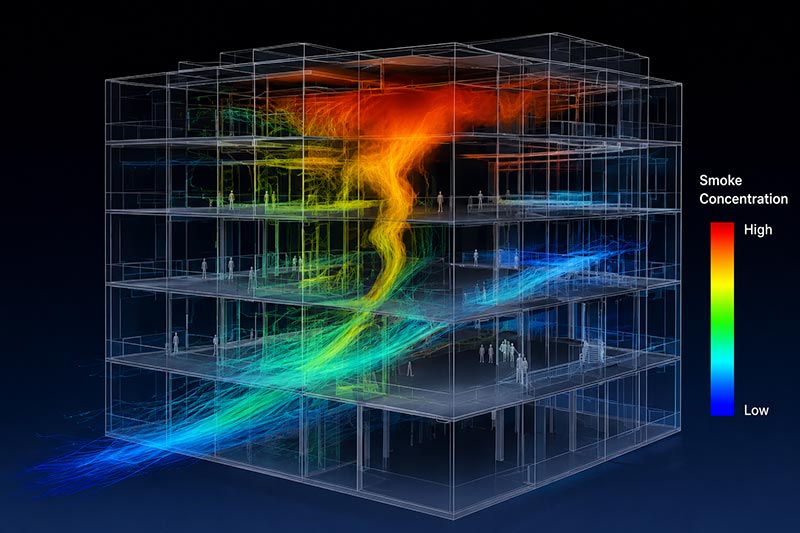
CFD (Computational Fluid Dynamics) modelling is a powerful fire engineering tool used to simulate how smoke, heat and gases move within and around a building during a fire.
It allows us to assess complex fire scenarios that go beyond the limits of traditional prescriptive methods, providing insight into conditions that affect life safety, structural integrity and building performance.
CFD modelling supports performance-based fire engineering solutions and is often used to demonstrate compliance within the Building Regulations when alternative or innovative designs are proposed.
Evidence Base
Provides clear modelling evidence to support fire safety design decisions.
Design Optimisation
Helps identify improvements to layouts, ventilation and smoke control systems.
Smoke Movement
Assesses how smoke, heat and gases may move through the building.
Regulatory Support
Supports discussions with Building Control and other approving authorities.
When is CFD Modelling Used?
CFD is used when standard fire safety guidance does not adequately address the complexity of a building or design proposal. Typical applications include:
- Large atria and open plan spaces
- Tall buildings and mixed-use developments
- Smoke ventilation and building exhaust systems
- Transport hubs, stadia and performance venues
- Healthcare, industrial and specialist facilities
CFD modelling provides robust evidence to support fire strategies, justify design decisions and gain approval from building control and other stakeholders.
What CFD Modelling Can Help Assess
A fire strategy outlines how your building will behave in the event of a fire and how people can safely escape. It evaluates key elements to protect lives, property, and business continuity.

Movement Of Smoke
Predicts how smoke spreads throughout spaces and escape routes.

Heat Transfer Monitoring
Analyses temperature distribution and thermal effects on people and structures.

Evacuation Conditions
Evaluates tenability in escape routes to support safe evacuation strategies.

Ventilation Performance
Assesses natural and mechanical smoke ventilation systems and their effectiveness.

Complex Geometries
Allows accurate modelling of unique or unconventional building designs.
Our CFD Modelling Process
We review your building plans, fire safety requirements and project objectives to identify the right approach from the outset. Our team then provides clear, practical guidance to support compliance, reduce risk and keep your project moving forward.
1
Brief & Objectives
We understand your project, design intent and performance requirements.
2
Model Development
A detailed 3D model is built to accurately represent the building and fire scenarios.
3
Simulation & Analysis
CFD simulations are run to model fire, smoke and airflow behaviour over time.
4
Results & Visualisation
We analyse results and produce clear visual outputs and data interpretation.
5
Reporting & Support
A comprehensive report is provided to support design, compliance and regulatory approval.
How To Get A Quote
To request a quote, send us the key project information, including the building address, building type, project stage, drawings, fire strategy documents and any relevant reports.
We will review the information provided and confirm the most appropriate scope, fee and programme.
Where the scope is not clear, we can arrange an initial call to understand the project and agree on the required output.
Need Fire Safety Support?
Speak to Independent Fire Engineering Ltd for professional advice, detailed inspections and straightforward reports that help you understand your building’s fire safety requirements.
Frequently Asked Questions
What is CFD modelling?
CFD modelling, or Computational Fluid Dynamics modelling, is a specialist fire engineering method used to simulate the movement of smoke, heat and gases within a building. It can help assess how a fire may develop, how smoke may spread, and whether proposed smoke control or ventilation systems are likely to perform as intended.
In fire safety design, CFD modelling is often used where standard guidance does not fully address the building layout, smoke control strategy or design challenge.
It can provide useful evidence to support design decisions, fire engineering assessments and discussions with approval bodies.
What types of project benefit from CFD modelling?
CFD modelling is particularly useful for projects where smoke movement, heat build-up or ventilation performance needs to be assessed in more detail. This can include complex buildings, atria, basements, car parks, shopping centres, warehouses, high-rise buildings, large open-plan spaces and buildings with unusual layouts.
It may also benefit projects involving smoke control systems, natural or mechanical ventilation, extended travel distances, performance-based design, or proposals that move away from standard prescriptive guidance.
By modelling different fire scenarios, CFD can help identify potential issues before construction or refurbishment work is completed.
Is CFD modelling accepted by Building Control?
CFD modelling can be accepted by Building Control when it is carried out properly and forms part of a clear fire engineering approach.
In most cases, Building Control will want to see that the modelling is based on sensible assumptions, realistic fire scenarios and a clear explanation of the results.
The study should also explain what is being tested, the acceptance criteria, and how the findings support the proposed fire safety design.
It is usually best to discuss the modelling approach with Building Control or the relevant approval body at an early stage. This helps ensure the scenarios, assumptions, and objectives are understood before detailed modelling work begins.
How long does a CFD study take?
The time required for a CFD study depends on the building’s size, the design complexity, and the number of scenarios to be modelled.
A straightforward study may take a few weeks, while larger or more complex projects can take longer. Time is needed to review the available information, agree on the assumptions, build the model, run the simulations, check the results and prepare the final report.
Providing accurate drawings, fire strategy information, ventilation details and design objectives at the start of the process can help avoid delays.
When is CFD modelling needed?
CFD modelling may be needed where standard fire safety guidance does not fully answer the design question. This is often the case when smoke movement, heat exposure, ventilation performance, or tenability conditions need to be examined in more detail.
It may be used for buildings with large open spaces, complex escape routes, basements, car parks, atria, unusual geometries or bespoke smoke control systems.
The aim is usually to assess whether conditions are likely to remain suitable for evacuation, firefighting access, or the intended fire safety strategy across the selected fire scenarios.
What information is needed for CFD modelling?
A CFD study usually starts with accurate drawings and a clear understanding of the building layout, use and design objectives.
The information needed may include floor plans, ceiling heights, fire strategy details, proposed fire scenarios, ventilation information, smoke control arrangements, extraction rates, inlet air paths and details of how systems are expected to operate during a fire.
Where information is missing, assumptions may be made, but they should be clearly recorded. Better information at the start usually leads to a more useful and reliable modelling study.
How does CFD modelling support fire safety design?
CFD modelling supports fire safety design by giving a clearer picture of how smoke, heat and gases may behave in selected fire scenarios.
The results can help assess visibility, temperatures, smoke layer height, ventilation performance and the effectiveness of smoke control systems. This information can then be used to support design decisions, review potential risks and provide evidence for discussions with Building Control, design teams or other stakeholders.
It is especially useful where a project needs a performance-based fire engineering approach rather than a simple prescriptive solution.
Related Services
Fire Risk Assessments
Clear, practical fire risk assessments to help you identify hazards, improve safety and meet your legal duties.
Compartmentation Surveys
Detailed surveys to assess fire-stopping measures, hidden breaches and the integrity of implemented escape routes.
Fire Door Inspections
Professional fire door inspections to check condition, compliance, gaps, seals, closers and overall performance.
Fire Engineering Consultancy
Specialist engineering support for complex buildings, design queries, compliance issues & project planning.
Ready To Protect Your Building?
Contact our fire engineering experts today for tailored fire strategy solutions.